
PRINT AS PDF
France has endured its worst heatwave on record. The extreme heat also toppled all-time national records in Jersey and Switzerland and set a new June temperature record in the United Kingdom. In Paris, the event was especially extraordinary: Paris-Montsouris recorded two consecutive days with high temperatures of 40.0°C (104.0°F) or above for the first time since observations began in 1872. At Paris-Jardin du Luxembourg, the heat reached a staggering all-time high of 42.2°C (108.0°F).
Through June 25th, France had recorded 225 all-time record-high temperatures during June. That figure dwarfs the previous June benchmark of 142 all-time records set in 2019. The next-highest year, 2022, saw just 7.
The scientific context is clear. Climate change is warming Europe faster than the globe as a whole, increasing the likelihood of more frequent, more intense, and longer-lasting heatwaves. Given that reality, one would expect news coverage of an unprecedented European heat event to place climate change at the center of the story.
A review of 24 news stories about the heatwave found that nearly 80% did, in fact, connect the event to climate change. But beyond that basic linkage, the coverage was far weaker. Fewer than one-third of the stories that mentioned climate change explained the central role fossil fuel burning plays in driving the warming trend that makes such extremes more likely and more severe.
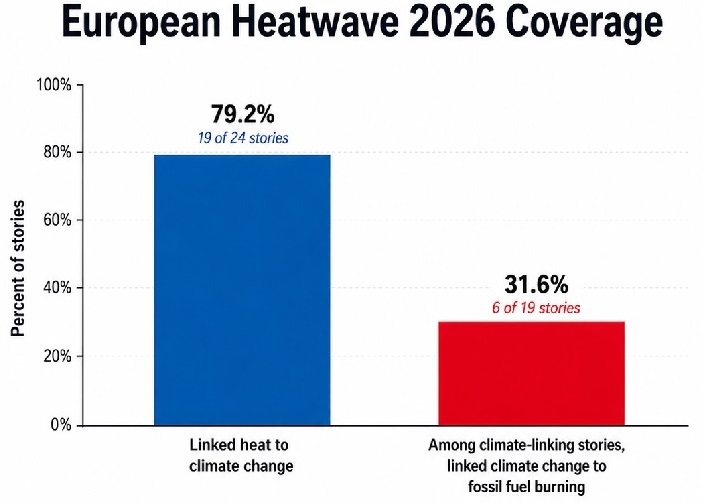
That omission matters. When journalism links heatwaves to “climate change” without explaining that the primary driver is the continued burning of coal, oil, and gas, the public receives an incomplete story. Climate change can begin to sound like an abstract force, a background condition, or an unavoidable natural trend rather than a human-caused crisis with identifiable causes and available solutions. Failing to name fossil fuels weakens public understanding, blurs accountability, and makes it easier for policymakers, industries, and institutions to avoid the hard choices required to reduce emissions. In the middle of a record-shattering heatwave, that missing link is not a minor detail. It is the difference between describing the disaster and explaining why it is getting worse.
The lesson from France’s heatwave is not simply that records are falling. It is that the climate baseline is shifting rapidly, and the public needs journalism that explains not only what is happening, but what is driving it.

