PRINT AS PDF
History rarely turns on a single event. But when it does, the consequences can be seismic. In such moments, a great power or empire may discover, almost overnight, that the authority and influence it spent generations building, often at enormous economic, financial, and human cost, has slipped beyond recovery.
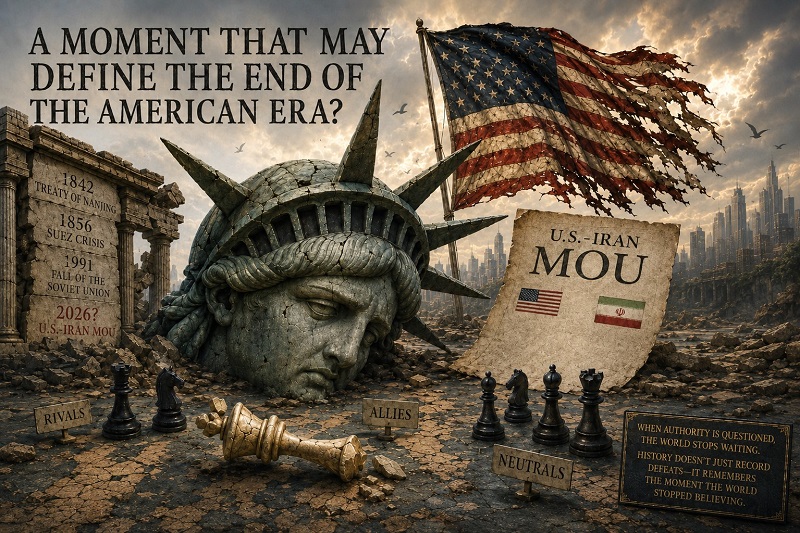
Such moments have occurred before. The Treaty of Nanjing in 1842 ended the First Opium War and helped inaugurate China’s long “century of humiliation.” The Suez Crisis of 1956 shattered Britain’s and France’s claims to world-power status. The dissolution of the Soviet Union in 1991 marked the permanent collapse of a former superpower. The Trump Administration’s Memorandum of Understanding (MOU) with Iran may come to be seen as the latest such event.
Beyond the immediate national humiliation, the MOU may provide psychological confirmation of something more profound: that the United States is overextended, unable to impose its will even on weaker states, and approaching the end of its era as the world’s indispensable power. It could be read as evidence of several long-building structural weaknesses an eroded military-industrial base unable to produce weapons at the scale required for a major conflict; chronic excessive budget deficits driving a growing federal debt burden, and a political system increasingly unable to align commitments, resources, and strategy.
Recognition is often what turns a moment of weakness into a historical rupture. A defeat, humiliation, or failed gamble may damage a great power, but the deeper loss occurs when allies, rivals, markets, elites, and citizens begin treating it as evidence that the old order is ending. From that point forward, the event can become self-fulfilling. Allies hedge. Rivals probe. Neutrals stop deferring. Domestic factions lose confidence. Deterrence becomes costlier, because authority must be proved again and again.
Decline, in this sense, is not only something that happens to a great power or empire. It is something that happens around it, as the world revises its expectations and begins behaving as though the power’s former dominance has already passed.
The Administration’s rapidly shifting explanations of the published MOU, coupled with its unwillingness to provide a credible alternative text, is deepening the impression that it has misled the public, its allies, and the world. In turn, these developments may foster the perception that the United States is weaker than previously believed. Once such perceptions take hold, they can become self-reinforcing.
Already, international headlines are beginning to capture the nature of the moment. Foreign Affairs writes, “How the Iran War is Shaping a Post-American World.” Responsible Statecraft declares, “Iran war marks the end of American primacy as we know it.” Deutsche Welle asks, “Does the Iran war diminish US superpower status?” Geopolitical Monitor argues, “What the Iran War Reveals About the Limits of US Power.”
Together, these headlines do more than report events. They name the rupture. That naming matters. Once diminished American authority becomes a shared frame, other actors begin adjusting their behavior as though the shift has already occurred.
In the end, by abandoning a war it launched with little serious consideration of the possible outcomes, the Trump Administration may have set larger forces into motion that it cannot control. Some defeats, or even perceptions of defeat, carry psychological consequences far beyond their military cost.
Those defeats reveal that a great power is no longer feared, no longer competent, or no longer protected by the aura of inevitability. Future historians may look back on the Trump-Iran MOU as the moment America’s role as an indispensable power ended.