PRINT AS PDF
The Middle States Commission on Higher Education (MSCHE) held its annual conference during December 10-12. The use of artificial intelligence (AI) was featured in a number of presentations, as well as a pre-conference workshop.
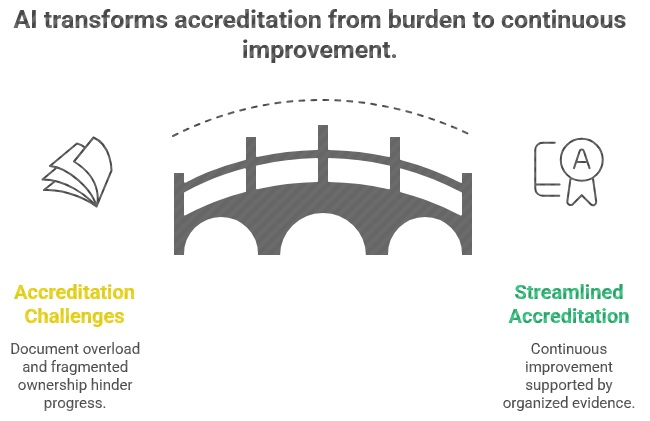
AI is increasingly reshaping how colleges and universities manage the complexity of accreditation, not by replacing professional judgment, but by strengthening institutional sense-making. As accreditation demands grow in scale, scope, and narrative coherence, AI-enabled evidence management offers a practical response to challenges that have long strained higher education systems: document overload, fragmented ownership, and uneven analytical capacity. When applied intentionally, AI supports accreditation as the continuous, improvement-oriented process it is intended to be.
Presentations by Excelsior University and Queens College laid a foundation for the use of AI to tag, classify, and map evidence across MSCHE’s accreditation standards. Accreditation evidence is rarely scarce. Instead, it is scattered, inconsistently labeled, and difficult to retrieve from silos. AI-assisted tools can scan large document repositories and tag materials by MSCHE standard, evidence type, date, and institutional priority. When extended to cross-standard mapping, these tools reveal how a single artifact supports multiple standards, helping institutions move away from siloed narratives. This practice reduces redundancy and staff burden. It also creates opportunities for integrated storytelling.
AI also plays a critical role in gap detection and draft synthesis. By analyzing evidence coverage across standards, AI can flag areas where documentation is thin, outdated, or overly repetitive, providing early insight that allows institutions to respond proactively rather than reactively. In the writing phase, AI can synthesize large volumes of evidence into structured draft narratives, offering a coherent starting point for Self-Study chapters. These drafts allow faculty, staff, administrators, and students to devote greater time and attention reflection, and improvement.
Taken together, these practices point toward a future in which accreditation is not an exercise in compliance, but a journey into institutional capability. AI’s greatest contribution may lie in its making patterns visible, connections legible, and gaps actionable in ways that strengthen professional judgment. When deployed as a sense-making partner, AI enables colleges and universities to reclaim accreditation as a strategic, reflective, and evidence-driven process that informs planning, advances student success, and promotes continuous improvement.